
Ninety-two per cent of marketers now report using AI in some part of their workflow — but ask them to point to the revenue line it moved, and the room gets quiet.
That gap is the story of AI in SEO right now. The curiosity phase is over. Canadian agencies and in-house teams have moved past "let's test ChatGPT" into full operational integration: AI is writing meta descriptions, clustering keyword sets, drafting outlines, and parsing log files across enterprise sites in Toronto, Calgary, and everywhere between.
The problem? Most teams automated the wrong half of the job. They handed AI the thinking and kept the typing. It should be the reverse.
Here's a realistic, hype-free framework for deciding what to automate — and what to protect.
Section 1: Where Automation Helps (The Wins)
AI earns its keep when the task is high-volume, pattern-based, and verifiable. If a human would do it accurately but slowly, and you can spot-check the output, automate it.
1. Large-Scale Keyword Clustering and Intent Mapping
This is the single strongest use case, full stop.
Take a 40,000-keyword export from Ahrefs or Semrush for a national home services brand. A strategist grouping those manually burns two weeks. An AI-assisted clustering workflow — using SERP-overlap data plus semantic embedding — does it in an afternoon.
What you get:
- Topic clusters built on actual SERP similarity, not guesswork
- Intent labels (informational, commercial, transactional, navigational) applied consistently at scale
- Cannibalization flagged before it damages rankings
- Content gaps mapped against competitors in minutes
The strategy still belongs to you. But the sorting? Let the machine sort.
2. Meta Tags and Structured Data at Scale
E-commerce catalogues and multi-location service sites are where automation pays for itself fastest.
A Canadian retailer with 8,000 SKUs needs 8,000 unique title tags and meta descriptions. Nobody is writing those by hand. AI generates them from product attributes, staying inside character limits and following your templating rules.
The same logic applies to schema markup. Generating valid JSON-LD for Product, LocalBusiness, FAQPage, or Service types is deterministic work. AI handles the syntax; you handle the validation.
Non-negotiable: Run every generated schema through Google's Rich Results Test before deployment. AI produces confident, well-formed, occasionally invalid JSON-LD.
3. Log File and Crawl Data Analysis
This is criminally underused.
Server log files are enormous, ugly, and full of insight. AI-assisted analysis surfaces patterns that would take a technical SEO days to isolate:
- Where Googlebot is wasting crawl budget on parameter URLs
- Which high-value pages haven't been crawled in 60+ days
- Crawl frequency drops that predate a traffic decline
- Bot behaviour differences between Googlebot, Bingbot, and the newer AI crawlers (GPTBot, ClaudeBot, PerplexityBot)
That last point matters more each quarter. If you want visibility in answer engines, you need to know whether their crawlers can even reach you.
4. First-Draft Structural Work
Content outlines, competitive SERP breakdowns, internal linking suggestions, and FAQ extraction from existing customer support tickets — all legitimate wins.
Notice what's missing from that list: the actual writing.
Section 2: Where Automation Hurts (The Risks)
Here's where teams get burned, usually six to nine months after they thought they'd won.
1. Generic Content Meets the Helpful Content System
Google's helpful content signals are now baked into the core ranking system. They aren't hunting AI content specifically — they're hunting content with nothing new in it.
Unedited AI output is, by design, a statistical average of what already exists. It is the definition of unoriginal. Sites that published hundreds of AI articles in 2023–2024 have watched traffic erode steadily, not in one dramatic penalty, but in a slow bleed as each page gets outranked by something with an actual point of view.
The test: If your article could have been written by someone who has never spoken to a customer, it will not rank long-term.
2. Hallucinated Facts and Fabricated Data
AI invents statistics with total confidence. It fabricates study citations. It misstates Canadian regulations, PIPEDA requirements, provincial tax rules, and CRA thresholds — with a straight face and a plausible-looking source.
For a YMYL site (finance, health, legal), one hallucinated claim published under an author byline is a genuine E-E-A-T liability. It's also a client trust problem that no ranking recovery fixes.
3. Brand Voice Flattening
Run 50 pages through the same model and they converge on the same rhythm, same sentence length, same tidy three-item lists.
Your brand voice is a competitive moat. A Barrie-based contractor and a Vancouver SaaS platform should not sound identical — but after enough automation, they do. Distinctiveness is the thing that makes people choose you over the cheaper option. Automating it away is expensive.
4. The Experience Gap
The first "E" in E-E-A-T is Experience, and AI has none.
It has never run a campaign, lost a client, fixed a botched migration, or learned that a tactic that works in a dense Toronto market falls flat in a rural service area. Original insight comes from doing the work. That's the part no model can generate, and increasingly it's the only durable ranking advantage left.
5. Content Decay Nobody Owns
AI makes publishing cheap, so teams publish more. But a 400-page content library nobody has audited in a year is a liability, not an asset. Thin, outdated, redundant pages drag down site-wide quality signals.
Volume without maintenance is just future cleanup work.
Section 3: The Golden Ratio — A Human-in-the-Loop Framework
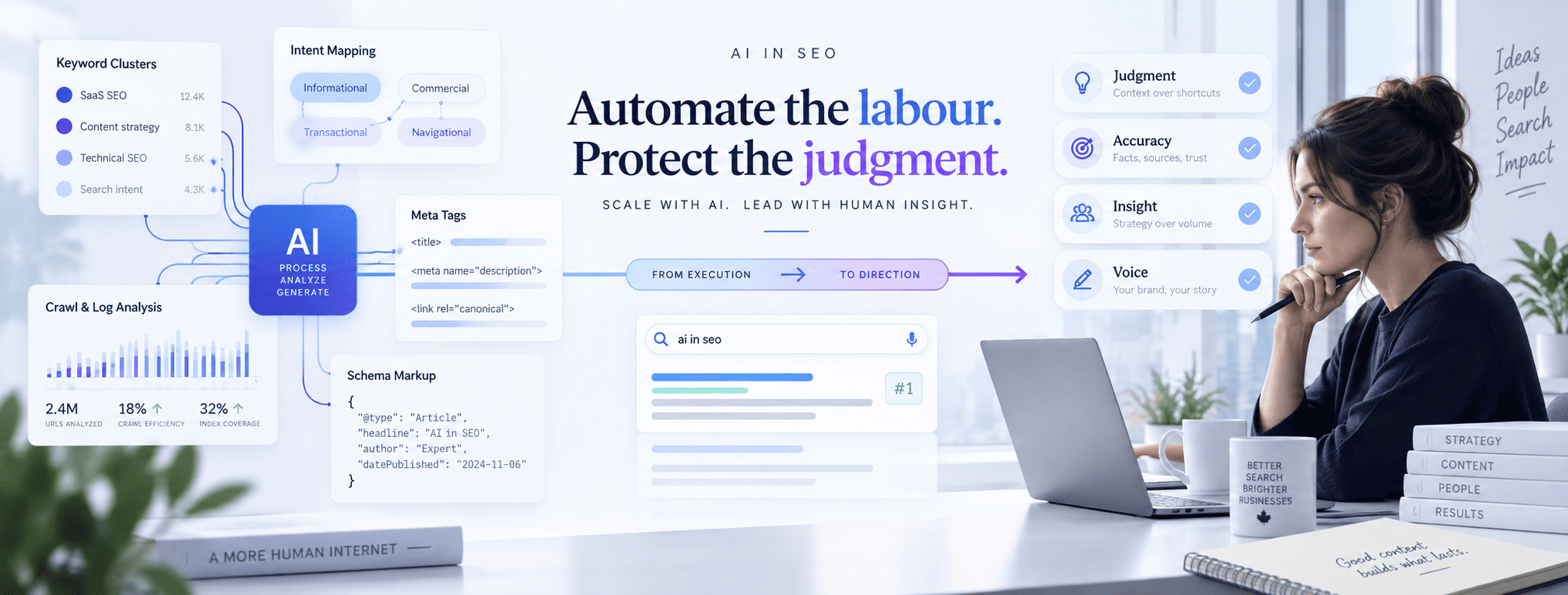
The working split most high-performing teams land on: AI handles 70% of the labour, humans own 100% of the judgment.
Split every workflow into two buckets.
Give AI the heavy lifting:
- Data aggregation, clustering, and classification
- Technical formatting (schema, tags, redirect maps)
- First-pass research summaries and outlines
- Pattern detection across large datasets
- Repetitive QA checks
Keep humans on the judgment:
- Strategic direction and prioritization
- Original insight, proprietary data, real case studies
- Fact-checking every claim, number, and citation
- Brand voice and editorial standards
- Final approval before anything ships
The Three Gates
Run every AI-assisted deliverable through these before publishing:
1. The Accuracy Gate — Is every statistic, date, and claim independently verified? No source, no publish. 2. The Insight Gate — Does this contain at least one thing a competitor couldn't have written? A client result, a contrarian take, a lesson learned. If not, send it back. 3. The Voice Gate — Does this sound like your brand, or like a language model? Read it aloud. You'll know.
If a deliverable can't clear all three, the automation didn't save you time. It just moved the work downstream.
The Takeaway
AI hasn't replaced SEO strategy — it's raised the floor on execution and raised the ceiling on what strategy has to deliver. When the mechanical work costs nothing, the only remaining differentiator is original thinking backed by real experience.
Automate the labour. Protect the judgment. Audit everything.
Start here this week: Pick your single most time-consuming recurring task — keyword clustering, meta tag generation, monthly reporting — and automate only that one. Measure the hours saved. Then reinvest those hours into something AI genuinely cannot do: talking to your customers.
What's your take? Where has AI actually delivered in your workflow, and where did it burn you? Drop your experience in the comments — the practical war stories are far more useful than the hype.
Need a clear-eyed assessment of where automation fits in your SEO program? Zaventra.io builds AI-assisted, human-led search strategies for Canadian businesses. Reach out for a technical SEO and content audit — we'll show you exactly what to automate and what to protect.